Charles Babbage’s God
This paper came from the “Babbage’s God” talk I gave at UVI in 2008 on the topic of Babbage’s suggestion that “God is physical,” and the later refinement where he suggested that laws of physics are God’s “divine legislature.” He then went on to invent the computer. The implication here is that the computer is the divine legislature, or Babbage’s God, and as Babbage applied this term to our universe, so he was the first to propose the universe is a computer. It is a fun topic. According to Wikipedia Konrad Zuse also wrote a book with the thesis that the universe is a computer, so I need to update this essay after I get a chance to read that.
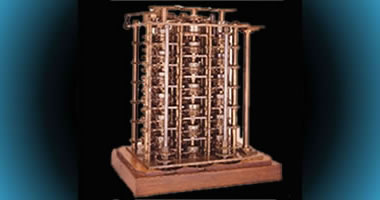
Designed a Modern Computer in 1845
The picture above is a recreation of Babbage’s difference engine by the London museum. This is a little more sophisticated than what we would call an ALU in a modern computer. It used a series of additions (recovering the finite differences) to calculate polynomials. In turn the polynomials were used to estimate functions. While building this machine Babbage realized that the control structure did not have to be built in, but rather could be placed under program control. Hence, in 1845 he designed the first modern computer, which he called the Analytical Engine.
The Analytical Engine was intended to be a mechanical beast, but that is irrelevant. The substrate upon which a computer is built certainly affects its performance, but does not affect whether it is a computer. In fact, ENIAC used an architecture of spinning gears; in this case each gear was a circular shift register of tubes. A flip-flop, which is the basis of memory in today’s computers, can be considered to be a gear with two index marks. Babbage’s machine gears, like those used in ENIAC, had ten index marks.
Babbage was a mathematician as well, and had mastered finite difference methods, a field of mathematics that is esoteric today. Before he designed the first modern computer he designed an arithmetic logic unit that used gears that could calculate sequences of values from a polynomial expression using finite differences. This is the so-called “Difference Engine.”
Two hundred years before the difference engine Blaise Pascal created a calculator for adding and subtracting using gears indexed to input numbers and then dialed back like an old rotary phone. These machines were popular, extending all the way to Babbage’s day. The Jacquard loom, a programmable machine, appeared in 1801. Babbage was also an industrialist and well-paid industrial consultant. He would have known of this machine. Factory mechanization was blossoming at this time.
Babbage did not find commercial backing for his machines. The primary use of the partially complete difference engine ended up being that of entertaining his dinner guests. Apparently it sat in his parlor. The machine impressed many people including visitors from other parts of Europe. His son Henry published Babbage’s work widely. So, though it is debated today, it appears likely Babbage’s work inspired a flourishing industry for calculating machines. Most people fail to realize that IBM was incorporated way back in 1896 as the Tabulating Machine Company, and it was not the first.
Though many professors and historians credit early pioneers such as Howard Aiken, John Atanasoff, John von Neumann, Konrad Zuse, and Eckert and Mauchly with the invention of the computer during WWII, these credits are obviously inaccurate or at least overly encompassing, as Church and Kleene were writing about lambda functions (calculating functions) as early as 1930 and Alan Turing set the foundation of computation theory with his publication of 1936. How can these people be creating computation theory if there were no computers?
There is evidence that politics has affected the published and perceived history of computing. All the great early computers were government funded and expensive. Babbage’s living room ornament cost the British government more than the price of a steam locomotive at a time when government-sponsored science was not well established. There were constant debates as to why that money was being spent on a machine when people were perfectly good at calculating navigation tables already. Babbage also had a reputation for being sacrilegious for having proposed a thesis topic in college that “God is physical.” This was ammunition for his political opponents. It appears likely that this character attack colors his reputation to this day.
Apart from Konrad Zuse, who was German, the other pioneers who are largely given credit for inventing the computer played a role in the glory of winning WWII. They worked on ballistics and nuclear bomb problems that caused unprecedented socio-political changes, the deaths of hundreds of thousands of people and brought the specter of the artificial annihilation of humankind. The implication is that anything that caused these changes must have been completely new, rather than a scaling up of things from before, but that implication is incorrect. As for their German counterpart, Zuse, his computers were used in helping design German airplanes, and credit for his work came as a politically correct afterthought some decades after the war.
His Inspirational Insight: “God Is Physical”
So Babbage reasoned that God might be physical. He reasoned that physics may in fact be the “Divine Legislator” representing God’s will, and from this he was inspired to design the computer as the incarnation of God. He set pen to the apotheosis of mankind, and simultaneously established the thesis that the universe is a simulation. He designed the computer both in body and soul.
In another essay on this website I establish an argument for the computer as the apotheosis of mankind in practical terms as an intelligent being that begins its early education with a database consisting of the knowledge of all mankind. In the “Babbage’s God” presentation I suggest also taking seriously Babbage’s proposal that the universe is a simulation. Furthermore, as the computer exists in our world, it follows that it can be used to simulate “child” universes.
Serious Consideration of the Physical God Hypothesis
It is difficult to approach the subject of the universe being a simulation in part because of the amount of science fiction that has been written on the topic of virtual worlds. But let us set aside the fantasy of a video-game world for a moment and give this hypothesis some serious consideration.
As one approach, if we can show that it is practical to simulate something on the scale of our universe on a modern computer, or perhaps an extrapolation of a modern computer, then it would certainly follow that our universe may be running in simulation. The logic goes as follows: (1) a universe such as ours will give rise to intelligent life; (2) it is natural that intelligent life will develop computers; (3) computers can simulate universes; (4) intelligent life will be motivated to create such simulations. Therefore we should expect that the universe is multifold.
The Question of Scale and Nyquist Sampling
The first attack on this thesis is often the question of scale. How could it be possible for a computer to simulate the activity of more particles than are in the computer in the first place? If there is a hierarchy of universe simulations, and each child universe simulation must be smaller and slower than its parent simulation, then there is a limitation to such recursion. The answer to this attack is that the particles in the simulated universe are only artifacts of the mathematics. The atomic entity is not the particle, rather it is the information bit, or less.
We know from the sampling theorems and results such as the Nyquist sampling rate, that seemingly analog processes can be simulated with 100% accuracy by only keeping track of a limited number of sample points. A colloquial analogy would be found in catching a baseball while blinking one’s eyes. A baseball in flight is “well behaved,” which means there is not much information in it. Just by seeing the ball leave the thrower’s hands, and perhaps a couple of other points, one can catch the ball. Though the complete system in all its details is complex, the essence of it is not. We can “just in time compile” from a few data points. Actually, the full details may never exist, but just be perceived to exist in the mind of the simulated being.
The Question of Energy and Non-entropic Computing
The second common attack is the question of energy. Due to the work of Ed Fredkin and others, we know that computation itself is non-entropic, which means that in the theoretical limit the only energy required is to pay for the results we take out of the machine. Also note that computation occurs when manipulating information, not in keeping track of “everything,” as explained in the prior paragraph. Hence, theoretically, our universe can provide a computer with enough energy to run a simulation of a system as complex as our universe.
When Will Universe-Scale Simulation Occur?
A number of authors have extrapolated technology trends such as Moore’s law to the point where the computer should be able to attain human-like intelligence. I examine this question in “Apotheosis Not Singularity,” arguing that we should rather consider the technology point where each computer can encapsulate the intelligence of all of humanity, an event called the “Apotheosis.” This paper raises a different question, one of when “Universe-Scale Simulation” will occur.
All problem solving can be viewed as simulation. When we solve mathematical problems we simulate the movement of symbols in our minds. When we drive a car we are constantly simulating physics so as to react appropriately. Minor universe simulation occurs constantly. Each person is in fact creating universes in their minds that, in a healthy person, help them navigate the externally manifest universe.
It follows that universe simulations will be inspired by those who are looking for the solution of difficult problems. Say we wanted to know “how the universe will end.” We could code our understanding of the parameters of this universe into, say, “field equations,” and then let the simulation go. Indeed, we would let time run much faster in the simulated universe than in the manifest universe so as to obtain useful information. We would then observe the evolution of the simulated universe in order to understand our own universe.
Basis for a New Philosophy
Babbage’s thesis is that the computer and its simulation software are God’s “divine legislator.” The implication here is that “God” or “Gods” could be some teenage hackers, scientists working on a government grant, or a special government committee. I find it ironic that my atheist friends are willing to accept that such a God is perhaps possible.
Given such models one may contemplate the possible personality of such a God or Gods, and the likely tools available for controlling such simulations, the likely objectives, and thus reason forward to justify a religion of spiritual expectations here on earth. It would seem reasonable that the activity of universe simulation would be regulated by laws based on what is “humane” and “moral” to create. If so, then within the simulated world these moral guidelines may be perceived as part of the universe as part of the laws of physics.
Another possibility of the purpose of a universe simulation is that of creating sustenance for the Gods. We know that our bodies need food, but does the mind need it also? Mind food would be input stimulus that is processed and then affected as a person uses that information to guide one’s actions. The mind food may be destroyed or reduced to another form in the process. If a higher intelligence requires such food, then it could be grown in a universe simulation. An analogy already exists in our own world when people play violent video games as a cathartic activity. In this sense, we as living beings could well be spirit cattle in simulation.
These two takes, problem solving and growing mind food, are not necessarily separate. One has to ask why people work on solving problems. If it is due to personal satisfaction, then problem solving is a kind of mind food. Watching someone be born, struggle, suffer, overcome or not – this is analogous to many movies we watch. Extrapolate this to watching whole worlds be born, billions of organisms struggling, suffering, and overcoming or not, and to the extent a person is intelligent enough to simultaneously, or perhaps over a lifetime of study, follow this – it is enthralling. Now extrapolate again, to a whole universe of worlds being born, and one can see why Krishna tells Arjun to fulfill his destiny.